


Hurricane Katrina in New Orleans. Hurricane Irma in Florida. The 2018 Camp Fire in Paradise, California. Landslides in Brazil. Droughts in Africa. Floods in Australia.
Each of these extreme weather events has a common culprit — climate change.
And each event has a typical outcome — the displacement of people with nowhere to go and a lack of resources to rebuild.
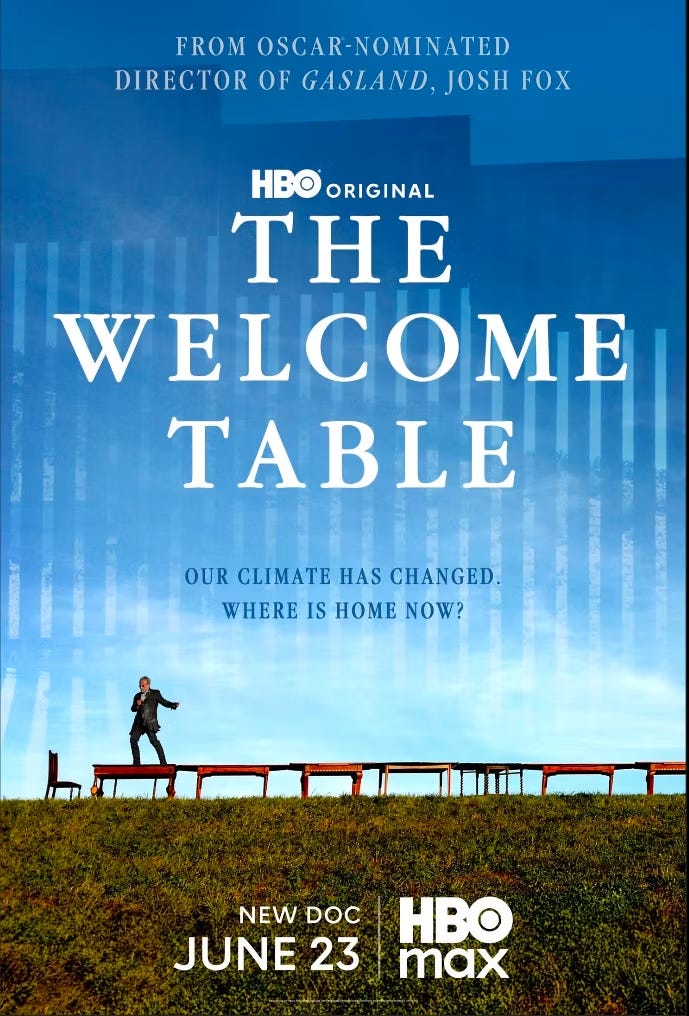
Josh Fox, director of the new HBO documentary The Welcome Table, brings these people together to share their stories over a literal 1,000-foot dinner table his team has constructed on top of a New Orleans levee.
Fox is no stranger to environmental filmmaking. In 2010, he wrote, directed, and produced the award-winning documentary Gasland, which helped galvanize the anti-fracking movement through its exposure of the environmental impacts of fracking on local communities. His more recent work includes The Edge of Nature (2025) about the “anthropause” during the Covid-19 lockdowns and How to Let Go of the World and Love All the Things Climate Can’t Change (2016), which premiered at the Sundance Film Festival and was also later released on HBO.
Fox’s newest project has a lot of the same themes about the climate crisis and its disproportionate effects on vulnerable populations, but it also comes with a rallying cry.
Yes, the individual stories of climate-fueled disaster are heartbreaking, but they are also instructive in that they follow a familiar pattern anytime someone’s home is destroyed. This loss is about more than just about losing a shelter or personal belongings. It’s about being pushed into a precarious existence where the only way to survive is to learn to rely on each other.
This theme of shared humanity and solidarity is often missing in other climate documentaries. But The Welcome Table stays rooted in a message of hope — not the kind that is dependent on unprecedented government action and technological breakthroughs, but rather the kind of hope defined by human empathy and compassion.
One of the most memorable scenes in The Welcome Table is set in the Italian town of Riace, not far from where Fox’s grandparents grew up. Riace is much like other towns in southern Italy in that it’s been hollowed out from decades of emigration by Italians to America. But what differentiates Riace is its former mayor, Domenico “Mimmo” Lucano, who is trying to reinvigorate the town by welcoming migrants coming from across the Mediterranean. This so-called ‘Riace model’ has inspired countless other communities across Europe that are struggling with the twin challenges of structural economic decline and migrant integration.
Part of the problem with implementing this model more widely is that, legally, there is no such thing as a climate refugee.
Policy vs. reality
The 1948 Universal Declaration of Human Rights (UDHR) is considered a historic document in laying out a legal framework for human rights. Among the universal rights UN member states agreed to are:
Article 13: Everyone has the right to freedom of movement and residence within the borders of each state. Everyone has the right to leave any country, including his own, and to return to his country.
Article 14: Everyone has the right to seek and to enjoy in other countries asylum from persecution.
The 1951 Refugee Convention and its 1967 Protocol built on these basic rights by defining the term ‘refugee’ and outlining their rights and the international standards of treatment for their protection.
A refugee is defined as someone who “owing to well-founded fear of being persecuted for reasons of race, religion, nationality, membership of a particular social group or political opinion, is outside the country of his nationality and is unable or, owing to such fear, is unwilling to avail himself of the protection of that country; or who, not having a nationality and being outside the country of his former habitual residence as a result of such events, is unable or, owing to such fear, is unwilling to return to it.”
But nowhere does the document mention what legal status someone should fall under when their home becomes uninhabitable. That means someone displaced from their home due to rising sea levels, extreme weather events, or environmental degradation does not qualify for the same protections as a “typical” refugee.
But as The Welcome Table makes clear, there is no such thing as a “typical” refugee anymore.
1 out of every 3 people will lose their homes due to climate change
The UN estimates that at least 1.2 billion people globally will be displaced by climate change by 2050
Of course, the communities with the fewest resources — and the least responsibility for causing the crisis — are among the hardest hit. But even middle and upper class people are not immune to climate threats. Just ask the hundreds of people working in Hollywood who lost their Malibu homes in the 2025 Palisades Fire. Or the Swiss village of Blatten that was flattened by a landslide caused by a collapsing glacier. Or the 108 people who lost their lives when Hurricane Helene smashed into North Carolina in 2024.
These disasters are only becoming more frequent as the planet warms and climate impacts intensify. Nobody wants to leave their home, but increasingly people are left with no choice.
The Welcome Table doesn’t shy away from the scale of the problem, but it also hints at a potential solution.
The mission of the film, according to the promo materials, is to use stories to “build empathy and outrage for the current situation, and in the wake of destruction, we see the power of communities to care for each other - the inspiring acts of bravery and mutual aid within communities and throughout diasporas offer a map for our survival.”
The table is a metaphor, laden with critical ideas about mutual aid, community, and policy changes necessary to help us face this migration crisis with dignity and care.
The film even comes pre-loaded with an impact campaign and several actions that concerned viewers can take.
Sponsor a table event in your city
Donate to the impact campaign to help bring the film to more people
Host a watch party with your friends or through your organization
No one action will solve the refugee crisis, let alone the climate crisis. But The Welcome Table works because it leaves viewers hungry for a seat at the table. Despite all the political and media rhetoric meant to divide us, nothing can overcome the power of human connection.
Dmitriy is a CFF volunteer and a Contributing Editor for Cinecology.
Background
Logline: Tells the story of climate refugees across six continents, celebrating the voices and experiences of people living at the forefront of the climate crisis, displaced from their homes by climate disasters.
Stream on HBO Max
Released on June 23, 2026
Directed by Josh Fox
Produced by International WOW Company
Learn more at
Climate themes include: extreme weather, wildfires, flooding, landslides, climate migration, climate refugees, human rights